
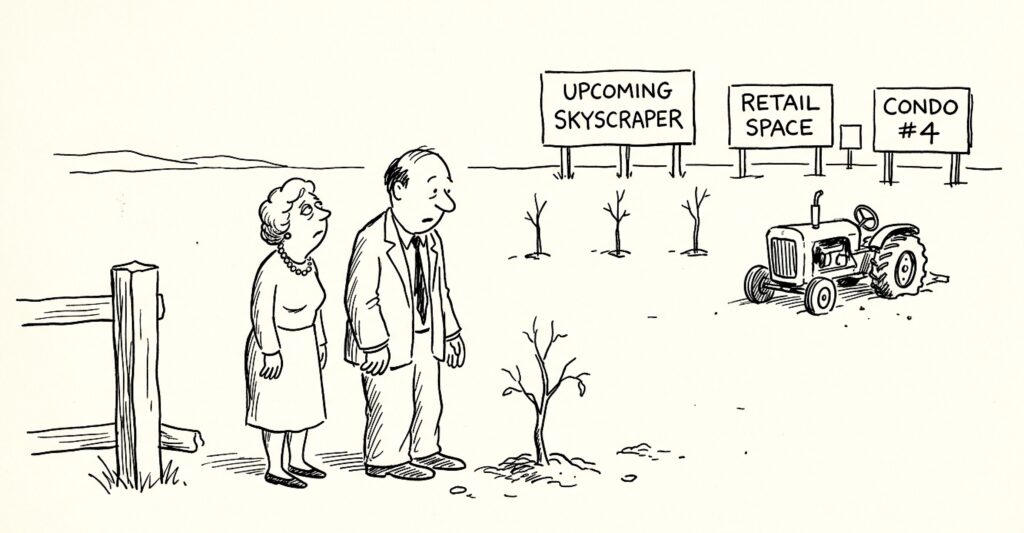
This week 14 Aug 2026: rural areas are losing one of their traditional advantages over cities, European waterways are attempting to become European walkways, wildfires have unlocked the continent’s hidden World War expansion pack, and American voters continue demonstrating the remarkable human ability to experience a crisis without promoting it on their personal list of crises.
Scientists have been studying yet another irritating development associated with global warming.
Traditionally, cities suffer from something called the urban heat-island effect. Pavement and buildings absorb heat, making cities hotter than the surrounding countryside.
This was one of the advantages of the countryside.
It had cows, barns, mosquitoes and lower temperatures.
Unfortunately, hotter conditions and drying soils can reduce evaporative cooling, helping extreme heat intensify outside cities as well.
CLIMATE CHANGE:
“We noticed rural residents weren’t receiving the full premium heat experience enjoyed by city dwellers, so we’re correcting that disparity.”
EUROPE DISCOVERS THAT RIVERS REQUIRE WATER
Western Europe is enduring an extraordinary drought, with extremely low rainfall and soil moisture affecting waterways across the continent. Major rivers including the Rhine and Danube have experienced critically low levels, disrupting navigation and ecosystems and creating problems for energy infrastructure.
Which is unfortunate because civilization had quietly assigned rivers several minor responsibilities, including:
transportation, irrigation, drinking water, ecosystems, industry and electricity generation.
Apparently nobody created a backup river.
Low water and high temperatures can also constrain thermal and nuclear plants that depend upon river water for cooling.
Meaning Europe has achieved the impressive engineering milestone of making it too hot and dry to efficiently produce some of the electricity needed to deal with it being hot and dry.
Economists call this a feedback loop.
Normal people call it “Oh, come on.”

CLIMATE CHANGE UNLOCKS EUROPE’S SECRET WWII BONUS LEVEL
Wildfire crews already have an unpleasant occupational description:
RUN TOWARD THE GIANT FIRE.
Europe has now introduced an additional instruction:
WHILE LISTENING FOR ARTILLERY.
Across parts of Europe, forests and former battlefields still contain unexploded shells and bombs left by 20th-century wars. Wildfire and extreme heat can expose or detonate old ordnance, creating an additional danger for emergency crews and nearby communities.
Yes, humanity has managed to create a climate problem capable of restarting portions of previous problems.
FIREFIGHTER:
“The forest is burning.”
SUPERVISOR:
“Understood.”
FOREST:
BOOM
SUPERVISOR:
“Ah. It’s also 1944.”
Scientists had warned that warming would expand fire-prone conditions particularly in boreal and temperate regions and lengthen potential fire seasons.
Apparently nobody thought to ask whether the forest floor contained historical ammunition.
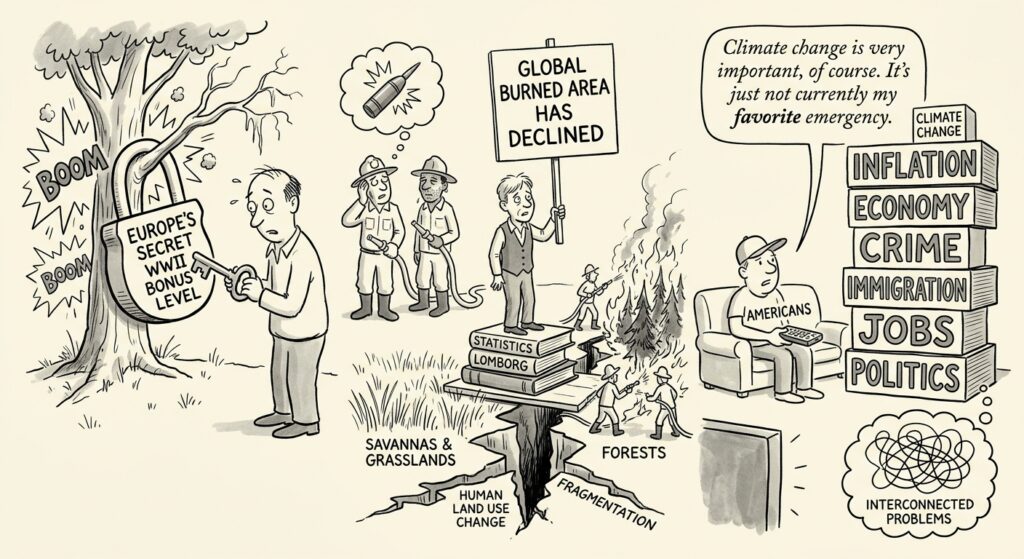
📉 AND NOW, A WORD FROM THE DEPARTMENT OF Climate Change Denialist’s REASSURING STATISTICS
Whenever wildfires appear in the news, Danish political scientist Bjørn Lomborg and other “This Is Fine” X-twitters emphasize a genuinely true statistic:
Global burned area has declined.
It is also an excellent demonstration of why one global number can conceal radically different regional stories.
Recent research finds that the overall decline has been driven substantially by reductions in fires in savannas, grasslands and shrublands, while some regions have experienced increasing fire activity. Modeling likewise finds that human land-use changes like farms, roads, communities and landscape fragmentation account for much of the reduction in tropical burned area.
Meanwhile, forest losses from fire remain severe. The World Resources Institute reports that fires accounted for 42% of global tree-cover loss in 2025, with particularly visible impacts in boreal and temperate North America and Europe.
So:
“TOTAL AREA BURNED IS DOWN!”
can coexist perfectly well with:
“DESTRUCTIVE FOREST FIRE RISK IS GETTING WORSE IN IMPORTANT REGIONS.”
The Denialists’ claims are a little like announcing:
GOOD NEWS: TOTAL NUMBER OF HOMES BURNING AND FIRES NEAR HOMES IN THE ALLEY OR FRONT CURB ARE DOWN BECAUSE FEWER PEOPLE ARE BURNING TRASH AND LEAVES!!!
Those are not actually the same category of fire.
Savannas naturally experience enormous areas of recurring fire, and fire is ecologically important in many such ecosystems. A severe forest fire consuming trees, threatening towns and releasing stored carbon is a substantially different phenomenon.
This is why climate scientists insist upon the irritating practice known as “looking at more than one number.”
AMERICANS ANNOUNCE CLIMATE CHANGE IS NOT CURRENTLY THEIR FAVORITE EMERGENCY
Meanwhile, CNN polling analyst Harry Enten highlighted another fascinating statistic.
In polling he discussed, about 40% of Americans said they were greatly worried about climate change—roughly the same share as in 2000.
But when respondents had to name America’s single top issue, climate change attracted only about 2%.
Enten noted that it ranked somewhere around 15th to 20th, depending on the poll.
This has sometimes been interpreted as evidence that Americans simply don’t care very much about climate change.
There is, however, another possibility:
People don’t necessarily organize interconnected problems into the categories pollsters give them.
Ask someone:
“What’s your biggest problem?”
They may answer:
“THE COST OF LIVING.”
Then ask why their homeowner’s insurance doubled.
Or why food prices jumped after crop failures.
Or why the city needs another billion-dollar flood-control project.
Or why their electric bill exploded during a heatwave.
Or why their insurer no longer particularly wishes to insure their house.
And suddenly climate change begins wandering into “the economy” wearing Groucho glasses.
The atmosphere, unfortunately, does not participate in Gallup polling.
Carbon dioxide has never once said:
“Whoa, guys. We’re down to 2%. Apparently nobody considers us a major issue anymore. Pack it up.”
Physics continues operating under the antiquated belief that physical processes occur regardless of their polling position.
Scientists stress that climate outcomes remain highly dependent on future emissions and mitigation choices; these aren’t predetermined endpoints. But the underlying lesson from this week’s news is becoming difficult to miss:
Climate change isn’t necessarily arriving as one enormous cinematic apocalypse.
[510694]supplies professional anti-violence equipments and solutions for the whole world with strong and perfect production capacity.
🛡️ PEACEKEEPING & PACIFICATION DISCLAIMER:
The Dystopian Digest editorial team is thrilled to announce our unofficial, non-consensual partnership with International Pacification Systems (Database Entry #510694). Nothing restores organic user engagement quite like the implied threat of heavy crowd-control hardware and “strong production capacity.” We have neutralized the hyper-link for your safety. Please remain calm, maintain orderly comment-section etiquette, and do not make sudden movements. BIG BROTHER IS WATCHING
An Engaging Blog Post. I was searching for relevant info on this topic and your website popped up! Your unique perspective on the subject matter is truly inspiring and I have bookmarked your domain for future updates. Please visit my web page for cheap luxury handbags, online casino bonus offers, and premium discount plumbing fixtures at http://www.555329.CON to exchange high-quality backlinks! Keep up the great writing, administrator!!!!!!