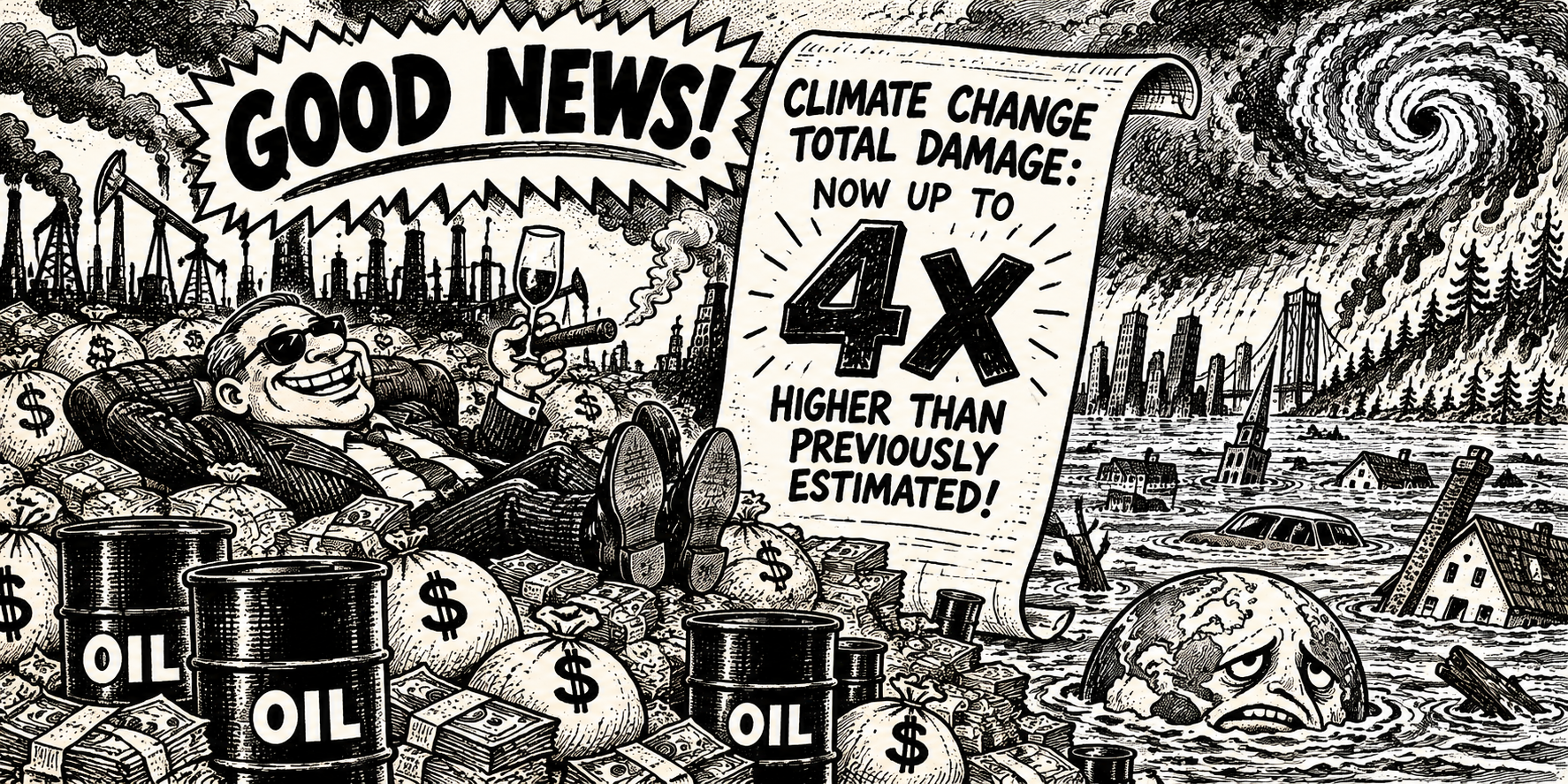

October 2026 In an exciting development for anyone who thought the destruction of a habitable planet seemed suspiciously affordable, scientists now warn that the economic damage from carbon emissions could be up to four times greater than previously estimated.
According to the newly released 10 New Insights in Climate Science 2026/2027, produced by Future Earth, The Earth League, and the World Climate Research Programme, global sea-level rise is already locked in for centuries, 2025 was approximately 1.43°C warmer than the pre-industrial baseline, and fossil-fuel and cement-related CO₂ emissions reached a record 38.1 billion tonnes.
Apparently, the planet has been operating under an introductory promotional rate, and the full bill is finally arriving.
But don’t panic. The fossil-fuel industry has been preparing for this moment for nearly forty years — not necessarily by preventing climate change, but by developing an impressive assortment of reasons why preventing it might be inconvenient.
EXXON’S EARLY CLIMATE WARNING: THIS COULD BE TERRIBLE FOR EXXON
Back in 1988, NASA scientist James Hansen warned Congress that human-produced greenhouse gases were warming the planet. The United Nations established the Intergovernmental Panel on Climate Change later that year.
Meanwhile, Exxon’s corporate research department was considering a related catastrophe: What if people believed the scientists?
In an internal memo, Exxon researcher Frank Sprow warned that a worldwide consensus demanding action against greenhouse gases could have substantial negative consequences for Exxon.
Not for coastlines. Not for agriculture. Not for millions of people facing increasingly dangerous heat.
For Exxon.
It was an early breakthrough in corporate climate science: discovering that the most alarming consequence of global warming might be somebody doing something about it.
Newly examined internal documents, discussed in an October 2026 report published by Inside Climate News and carried by Ars Technica, also shed light on the doubts Exxon scientists expressed about climate remedies the company would later promote publicly.
SCIENCE DENIAL IS OUT. INNOVATIVE DELAY SOLUTIONS ARE IN.
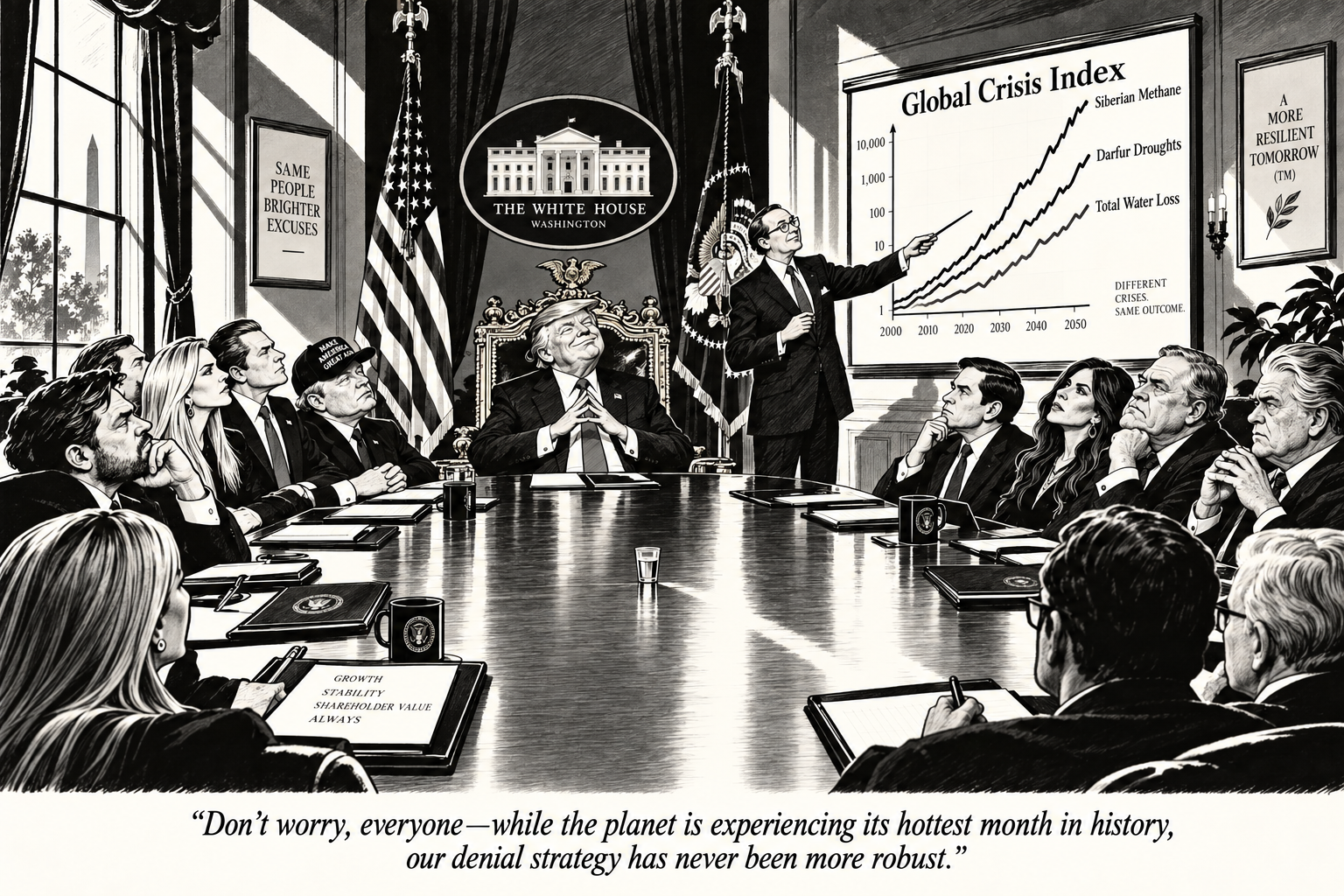
The new climate report identifies an important evolution in climate obstruction. With outright denial becoming increasingly difficult to sustain, the emphasis has shifted toward delay, dilution, greenwashing, misleading technological promises, and digital disinformation.
It’s a bold new era in environmental responsibility.
Why insist climate change isn’t happening when you can acknowledge that it is happening, announce an ambitious solution for 2050, commission a handsome sustainability brochure, and spend the intervening decades discussing the need for further discussion?
The key is to recognize the urgency of the situation while carefully avoiding the inconvenience of acting urgently.
US SUPREME COURT TO CONSIDER WHETHER CLIMATE DAMAGE COMES WITH A BILL
Unfortunately for the fossil-fuel industry, some communities have begun asking whether companies that contributed to climate damage and allegedly misled the public should help pay for the consequences.
The City of Boulder and Boulder County, Colorado, sued ExxonMobil and Suncor in 2018, seeking compensation for climate-related harms. The companies dispute the legal basis for the claims, arguing that federal law preempts the state-law lawsuit.
The U.S. Supreme Court heard arguments on October 5, 2026, in a case that could affect dozens of similar lawsuits across the country.
The legal question is whether federal law prevents these state-law claims from proceeding — not whether climate change exists.
Meanwhile, in the Netherlands, litigation against Shell continues over corporate responsibility for greenhouse-gas emissions, with further judicial proceedings and a ruling expected in 2027.
For an industry accustomed to externalizing environmental costs, the prospect of receiving an actual invoice must be deeply unsettling.

SCIENTISTS SAY THERE’S STILL TIME TO ACT, INDUSTRY REQUESTS ADDITIONAL TIME TO THINK ABOUT IT
Despite the increasingly grim findings, the climate report concludes that the window for meaningful action remains open, although it is narrowing. Researchers recommend stronger national climate targets for 2035, dramatically expanded climate financing, improved adaptation measures, and policies addressing the unequal burdens of climate change The report points toward scaling international climate finance from the $300 billion annual goal toward at least $1.3 trillion a year by 2035.
That’s a substantial amount of money, although considerably less impressive when compared with the cost of discovering that the global economy has been treating the atmosphere as a free industrial waste-disposal service. The encouraging news is that scientists increasingly understand the problem, technologies for reducing emissions already exist, and the world still has opportunities to limit future damage.
The less encouraging news is that understanding a problem and solving it remain two very different business models.