From heavy metals in Norwegian tap water to troubled American weather satellites and a proposed FEMA shake-up, humanity unveils its bold new disaster-management strategy: Every State for Itself.
DYSTOPIAN DIGEST — October 21, 2026
LONGYEARBYEN, NORWAY — In a stunning breakthrough for the rapidly expanding field of Things That Used to Work, The Guardian reports residents of one of the world’s northernmost towns have discovered that turning on the kitchen faucet is no longer necessarily a good way to obtain drinking water.
The culprit? Climate change, which has apparently grown bored with melting glaciers, flooding coastlines, and setting forests on fire, and is now experimenting with poisoning the plumbing.
Longyearbyen, a remote Arctic settlement on Norway’s Svalbard archipelago, has been experiencing some of the planet’s most dramatic warming. Unfortunately, the permafrost beneath the town has taken this as an invitation to resign.
As the frozen ground thaws, it exposes shale containing pyrite, commonly known as fool’s gold. When exposed to air and water, pyrite can generate acid, which releases naturally occurring metals into the water supply.
It’s a fascinating geological process, particularly for anyone who enjoys a refreshing glass of the periodic table.
At one point, manganese concentrations reportedly reached 25 times recommended limits, raising concerns about neurological effects, particularly in infants and children.
Although manganese levels have subsequently declined, elevated sulphate and nickel concentrations have helped keep the drinking-water restriction in place.
The town’s water supply, once known primarily for being wet, now offers a rotating selection of chemical surprises.
Local authorities have arranged for residents to collect free filtered water, with a local brewery helping supply it through supermarkets.
This represents an important milestone in human civilization: The beer people are now helping make the water safe.
Engineers are investigating long-term solutions, including new water infrastructure, sophisticated filtration, and possible desalination backup systems.
Scientists warn that communities in northern Canada and Alaska could face similar problems where thawing permafrost exposes comparable geology.
Meanwhile, America Considers the Advantages of Weather Surprises
Across the Atlantic, the United States is making its own contributions to the exciting new science of disaster management.
Alan Gerard at Balanced Weather reports:A Government Accountability Office report has identified significant unresolved cost, schedule, and management risks in NOAA’s geostationary weather satellite program.
These satellites are supposed to help meteorologists observe dangerous weather systems and provide the advance warnings that have traditionally allowed people to do frivolous things like evacuate, secure their homes, and remain alive.
The GAO findings raise concerns about potential future gaps in observation coverage or diminished capabilities.
But perhaps we’ve been looking at this all wrong.
For decades, Americans have enjoyed the unfair advantage of knowing that hurricanes are approaching before the roof blows off.
Where’s the spontaneity?
Where’s the adventure?
Where’s the pioneering spirit of our ancestors, who experienced catastrophic weather events without the luxury of animated satellite imagery and a meteorologist pointing at a giant red blob?
Imagine the excitement of waking up to discover that your house is now located in the next county.
Weather forecasting: Because apparently knowing the future has become an expensive government habit.
Of course, the GAO isn’t recommending that America abandon weather forecasting. It’s warning about risks that need to be addressed. But in an era when even drinking water can become an unexpected chemistry experiment, the prospect of additional uncertainty seems almost fashionable.
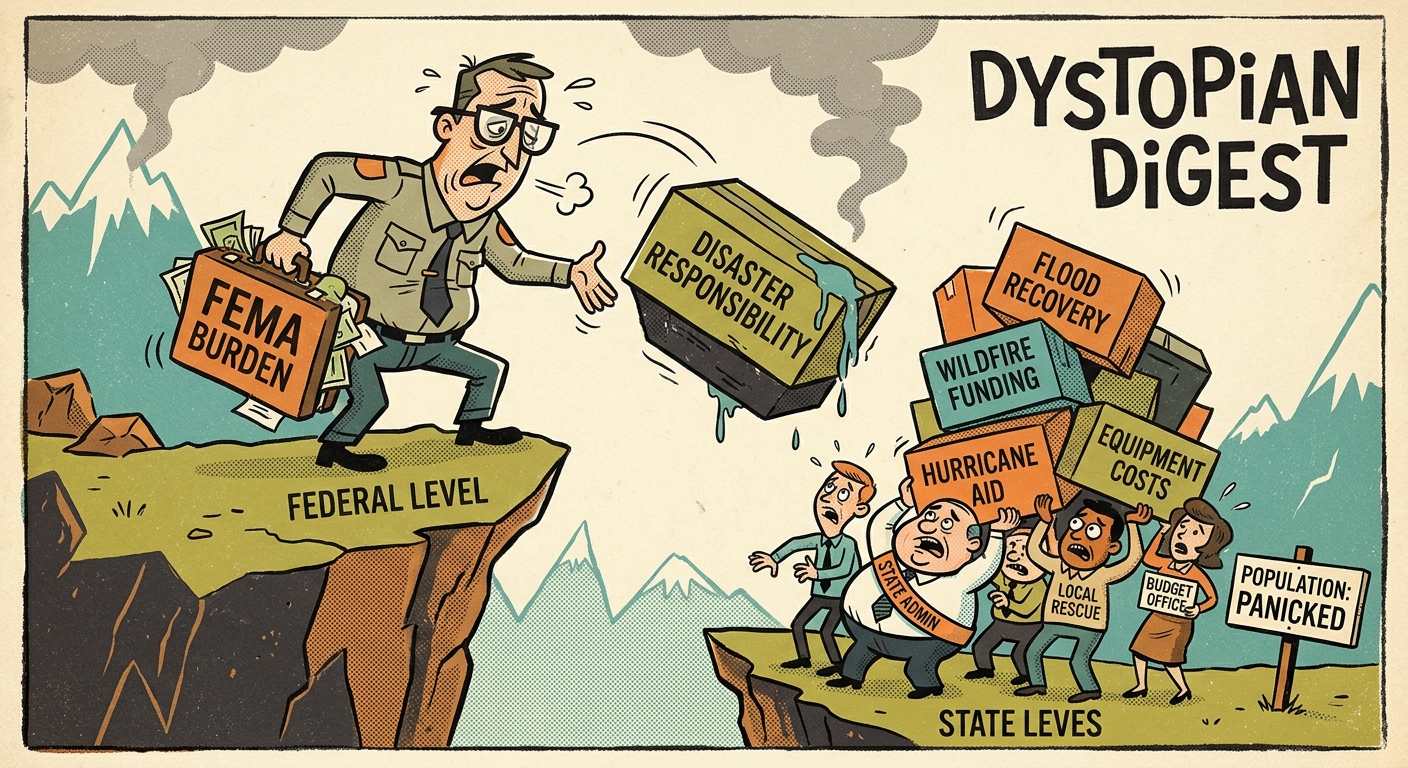
FEMA Unveils Bold New Strategy: Have You Tried Asking Somebody Else?
As if contaminated Arctic water and uncertain satellite schedules weren’t enough, the Trump administration is preparing a potentially significant change in how the federal government helps Americans recover from disasters.
According to remarks obtained by POLITICO, FEMA Administrator Cameron Hamilton has told state emergency management officials that states should build larger financial reserves and develop the capacity to handle most disasters with substantially less federal assistance.
The administration could begin implementing reductions in federal disaster aid in as little as six months.
In other countries, the government declares a state of emergency. In America, the government will now declare that the emergency is the state’s problem. Obviously hurricanes, tornadoes, droughts, floods, and wildfires are now local management issues.
And Finally, the Free Market Has a Solution: Disaster Insurance That May Not Survive a Disaster
Of course, there’s one small detail we’ve overlooked: insurance.
As climate change intensifies storms, floods, and wildfires—and the questionable wisdom of building expensive homes in places where nature routinely tries to repossess the property becomes harder to ignore—the cost of insuring those homes is skyrocketing.
In states like Florida, established insurers have raised premiums, restricted coverage, or abandoned parts of the market altogether.
Apparently, the insurance industry has finally discovered that repeatedly rebuilding houses in hurricane-prone areas is not an especially promising long-term business model.
But fear not! The free market abhors a vacuum, particularly one filled with desperate homeowners and mandatory mortgage insurance requirements.
As traditional insurers retreat, smaller, newer, and sometimes thinly capitalized companies have opportunities to fill the gap. Some may provide legitimate coverage. Others raise uncomfortable questions about financial resilience, reinsurance arrangements, and who ultimately pays when the really big storm arrives.
As labor journalist Hamilton Nolan explores in Insurance Is the Big Problem Hiding, the growing insurance crisis raises fundamental questions about whether the private market can continue providing affordable protection against increasingly costly disasters.
And here’s where modern financial innovation really shines.
Why operate an insurance company as a boring, financially stable institution that collects premiums, pools risk, and pays claims when you can structure one primarily to collect money, distribute profits, transfer liabilities, and hope the hurricane arrives after you’ve cashed out? With the right combination of financial engineering, optimistic risk models, and corporate structures resembling Russian nesting dolls, a poorly capitalized insurer can become something far more exciting than a provider of protection.
A financial extraction vehicle with a customer-service department.
The premiums are real. The profits are real. The executive compensation is very real.
The protection? Subject to terms, conditions, exclusions, available capital, and whether the company still exists when you need it.
And when the catastrophic losses finally arrive, the remaining bills may find their way to policyholders, other insurers, state guaranty mechanisms, or taxpayers.
It’s the miracle of modern risk management: Privatize the premiums, localize then socialize the catastrophe.
So rest assured, America. Between increasingly unpredictable disasters, uncertain federal assistance, and an insurance market struggling to price the uninsurable, your future is in excellent hands. Tremendous tiny orange hands.
Dystopian Digest reminds readers that insurance is a promise to pay for bad things that haven’t happened yet. Which is a wonderful business model, provided nothing bad ever happens.