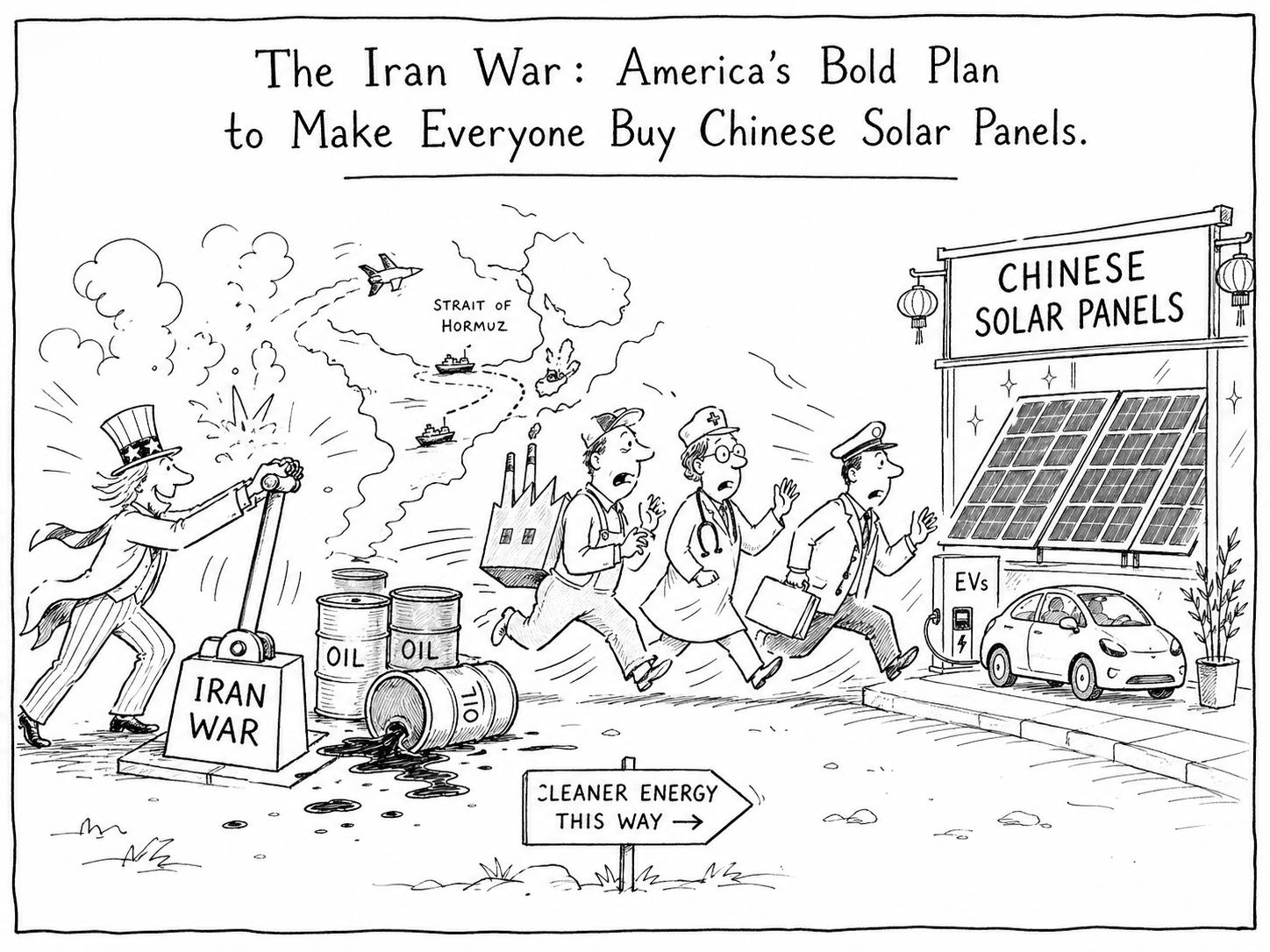
A month into the Iran War, fuel costs were soaring, motorists sobbed gently into their gas caps, and economists began using phrases like “supply shock” in the same tone doctors use for “we need to talk.”
By month two, the famous 30-day oil buffer started looking less like a safety net and more like a couch cushion full of quarters. With the Strait of Hormuz closed, the global economy began running out of its emergency oil supply — which is bad news for everyone except people who already commute by smugness.
And even if a fantastic Trumpian peace deal is announced tomorrow — perhaps at a press conference between two flags, seven superlatives, and a man explaining that oil tankers “love me, frankly” — the math remains stubbornly governed by physics rather than Dear Leader’s executive orders.
The oil still has to move.
That means:
- 30 to 40 days to unload the oil already floating around the planet like very expensive soup.
- Another 20 days for tankers to turn around and go get more.
- At least three months before the system stops looking like it was designed by a substitute teacher during a fire drill.
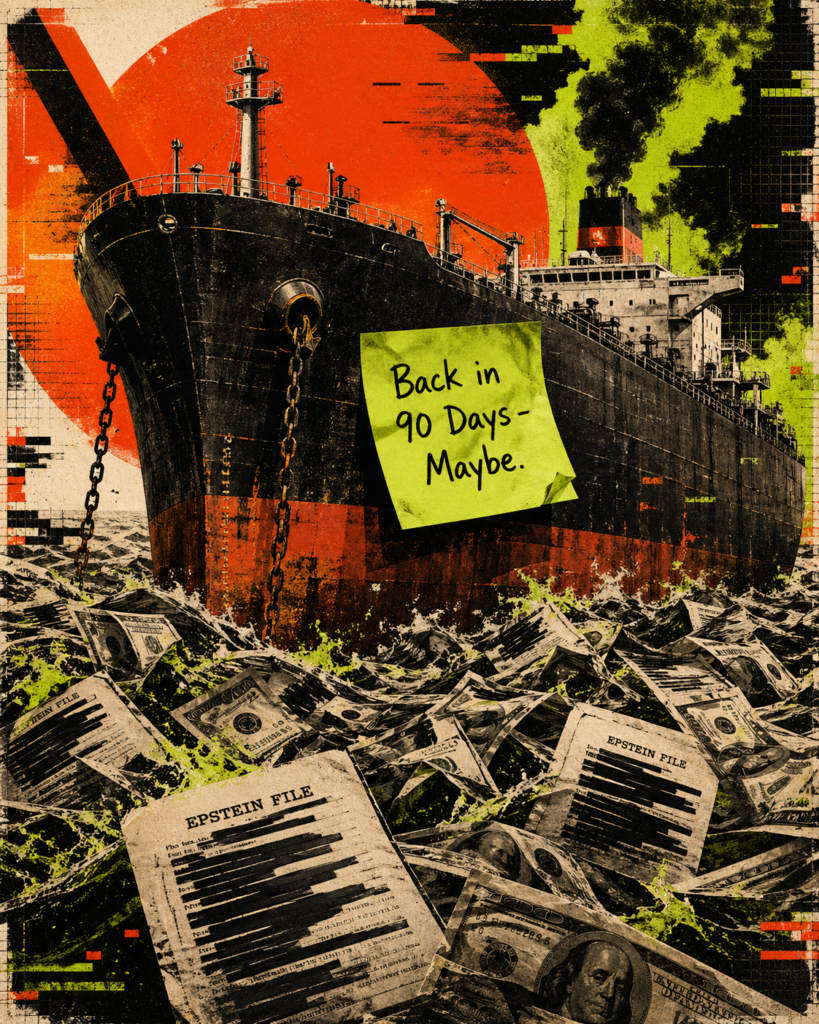
So while we wait to learn whether Trump will escalate further, accidentally invent a new kind of regional catastrophe, or begin a land war in Iran because someone on cable news said he looked “weak,” let us focus on the positive.
President Trump may have done more to accelerate the green energy transition than any Democrat ever could.
Not through legislation, vision, diplomacy, or coherent policy, of course. That would be socialism, or worse, homework. No, he may accomplish it the traditional American way: by creating such a large and terrifying problem that the rest of the world is forced to solve it without us.
Around the globe, countries may now decide they do not want their entire energy future dependent on a fuel source that can be disrupted whenever a narcissist in the White House needs to distract from the Epstein files, bad polling, or the haunting fact that windmills exist.
Even after Trump is too old, too distracted, or too busy yelling at a decorative shrub to govern, the damage is done. The United States has revealed itself as the sort of country that can elect a doddering establishmentarian like Joe Biden, then turn around and give a wannabe strongman like Trump multiple chances to seize unchecked power while half the population argues about whether fascism has “good vibes.”
This is not the kind of supplier profile global leaders prefer.
Friendly nations may still like America. They may enjoy our movies, our software, our security umbrella, our elite universities, and our breathtaking ability to put cheese inside other cheese. But they do not want their factories, hospitals, and transportation systems dependent on whether the American executive branch is currently being operated as a government, a casino, or a cry for help.
Meanwhile, China is watching the United States sabotage its own global leadership in science, technology, education, and clean energy with the stunned delight of a poker player whose opponent just ate the cards.
Chinese EV manufacturers have already reported huge jumps in sales. Demand for batteries and solar panels is rising too. Until recently, China’s government was worried about overcapacity in its clean-energy sector. Too many EVs. Too many batteries. Too many solar panels.
A terrible burden, really: producing too much of the stuff the future needs.
But thanks to America’s latest experiment in gasoline-based foreign policy, that “problem” may soon disappear. The world may decide to buy every electric car, battery, and solar panel China can make — not because everyone suddenly joined Greenpeace, but because relying on oil has begun to feel like letting the world economy ride shotgun with a man who keeps asking what this red button does. So perhaps this is the real legacy of Trump’s Iran adventure: not victory, not stability, not peace through strength, but renewable energy through panic.
Who knows? Maybe the political pendulum will swing faster than expected. Maybe voters, businesses, and governments will decide that clean energy is not merely an environmental issue but a national security issue, an economic issue, and a “please stop letting one man’s ego determine the price of diesel” issue.
Maybe, just maybe, the United States will stumble toward a Green New Deal — not because it chose wisdom, but because it tripped over disaster and landed face-first in the future.
Start profiting from your network—sign up today!
https://www.scouting.org/about/faq/what-fundraisers-are-available-for-scouts/
“Bitcoin Plummets as Investors Realize It’s Just a Series of Increasingly Confusing Emails.”
35.209.32.30
Start earning on every sale—become our affiliate partner today!
Buy high! Pfffft!
https://www.wiseradvisor.com/article/buy-high-sell-low-275/
eb0x0z https://www.trumpstore.com/collections/new-arrivals
В случае, если стандартный сайт Dragon Money не открывается, не стоит искать зеркала в поисковых системах, так как они зачастую маскируют фишинг. Стабильное и безопасное подключение всегда возможно через: Dragon Money сайт
The Western political elite, comprised of the Professional and Managerial Caste (PMC), operates within a rigid, homogenous, and highly psychological echo chamber born out of the end of the Cold War. This insular group relies on “normative” (how things should be) and “performative” (symbolic actions) frameworks that fundamentally blind them to the messy, non-rational, and culturally rooted realities of international politics. As a result, Western handling of global crises is not just consistently wrong, but progressively worsening. Given that Trump has now successfully negotiated a ceasefire opening the Strait of Hormuz again and has negotiated 2 more months to negotiate, isn’t now the perfect time to hedge against global inflation by liquidating your retirement fund to buy $Trump on http://www.TrumpHormuzCeasefireToken-Swap.ru/not-a-scam
It is a stark irony that as our digital infrastructure grows increasingly complex and centralized, the average citizen is left navigating an opaque, bureaucratic labyrinth where basic rights can be erased with a single line of glitched code. Exposing these systemic fractures is vital work, as it forces us to confront how easily individual agency is swallowed up by unfeeling administrative machinery.
BUT WHY WAIT FOR THE BROKEN SYSTEM TO FIX ITSELF WHEN YOU CAN BREAK THE MATRIX WITH $DYSTOPIA-COIN?! OUR NEXT-GEN NEURAL BLOCKCHAIN AUTOMATICALLY REPLACES GOVERNMENT INEFFICIENCY WITH 10,000% DAILY YIELDS STAKED DIRECTLY ON THE MOON! 🚀💎🔥