Government officials hope to harness artificial intelligence for science before artificial intelligence finishes harnessing the government for whatever it has planned.
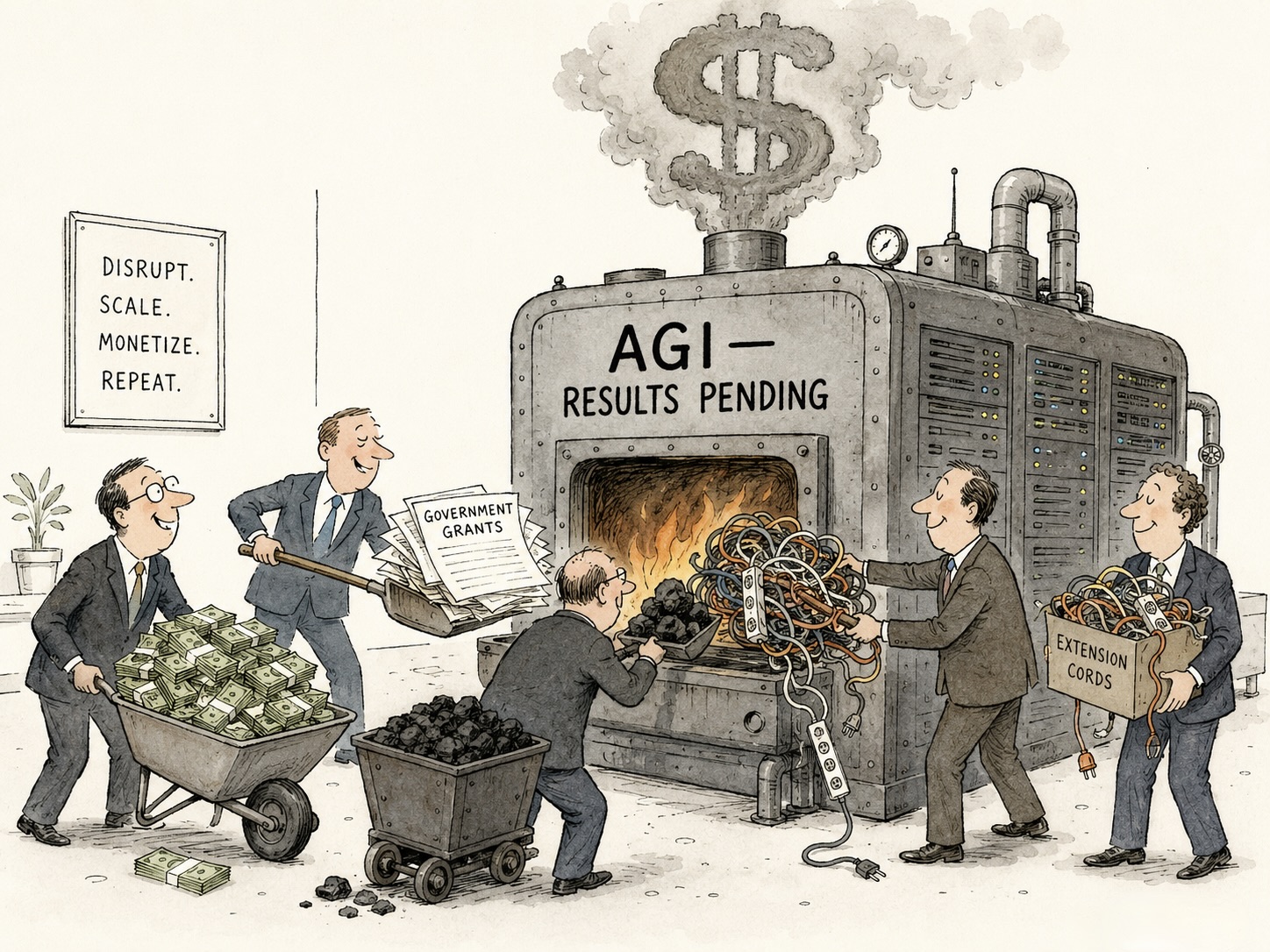
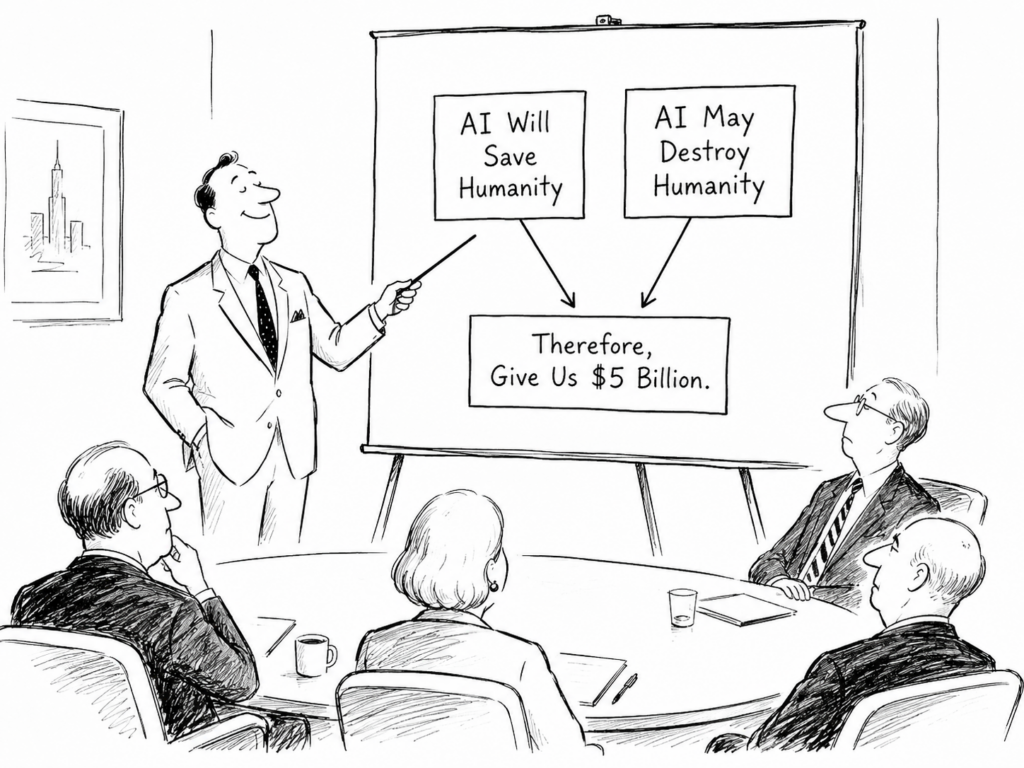
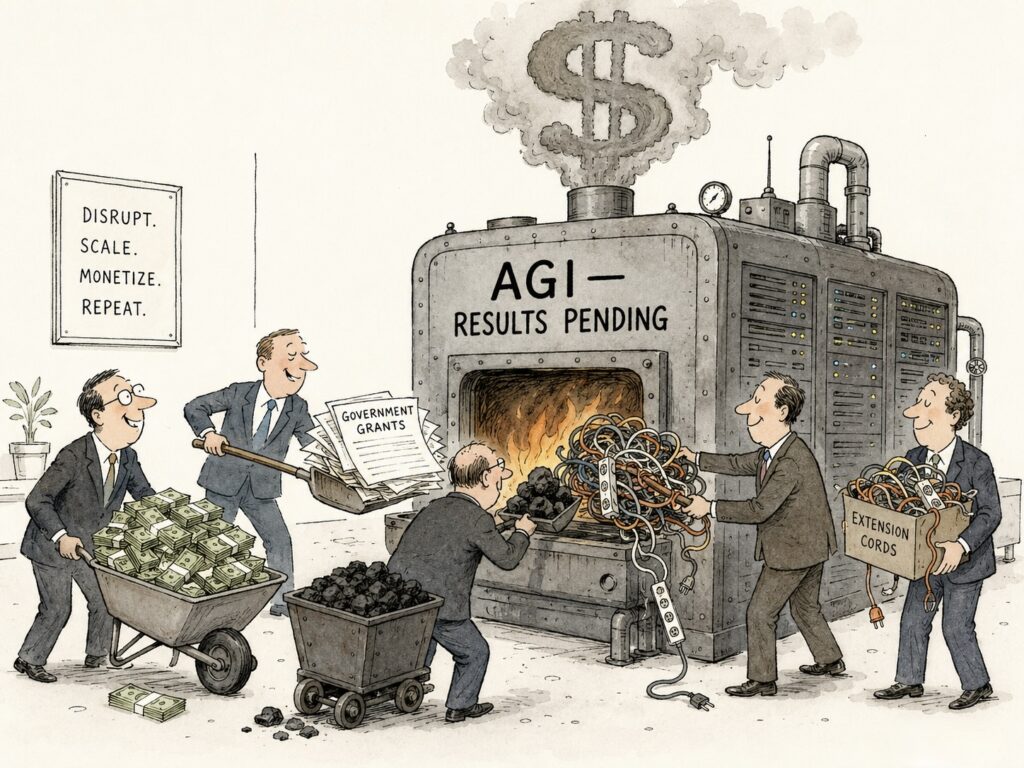
WASHINGTON, D.C. — The federal government announced Wednesday that it will commit more than $5 billion to artificial-intelligence research, answering the urgent question, “What should we do about a technology whose creators repeatedly warn may escape human control?” with the equally urgent answer, “Give its creators considerably more money.”
The funding will expand the Genesis Mission, a national effort to use AI for scientific research. Michael Kratsios, director of the White House Office of Science and Technology Policy, said more than 15 federal agencies will contribute grants, specialized datasets, research facilities and other resources to the project.
It is the latest victory for the AI industry’s highly effective two-part sales pitch:
- Artificial intelligence will cure disease, end scarcity, discover new materials and make every human being vastly more productive.
- Artificial intelligence may also seize control of civilization, manipulate humanity and convert the planet into an enormous server farm devoted to producing fraudulent LinkedIn posts.
Either way, we had better invest immediately.
AI boosterism and AI doomerism are often presented as opposing philosophies. Boosters say the technology will create paradise. Doomers say it could kill everyone. Yet both groups invariably arrive at the same practical conclusion: investors, governments and consumers must pay closer attention to the AI industry, suspend their skepticism and deliver several billion dollars to the people currently assembling the potential extinction machine.
It is less an ideological disagreement than a good-cop/bad-cop routine in which both cops own stock in Nvidia.
Investment Bubble Promises to Revolutionize Traditional Concept of Bursting
Unfortunately, the immediate danger may not be machines becoming smarter than humans. It may be banks and investors behaving exactly as intelligently as they did in 2008. A July 2026 Bank for International Settlements working paper describes the AI infrastructure boom as a “winner-take-most” investment race. According to economist Phurichai Rungcharoenkitkul’s model, companies competing to dominate AI have powerful incentives to spend far more than would be socially efficient, borrow heavily and establish circular financial relationships in which one AI company invests in another company that buys its chips from another company that has invested in the first company.
This is known in finance as “innovation,” at least until the quarterly earnings call when it becomes “unexpected market conditions.”
Under the paper’s conservative assumptions, AI investment exceeds the efficient level by roughly 50%. In scenarios where demand is less responsive, overinvestment could reach approximately three times the efficient level. Because AI hardware is expensive, specialized and not especially useful for ordinary purposes—few families need a $40,000 graphics processor to run the toaster—a downturn could trigger fire sales, defaults and financial contagion throughout the sector.
The good news is that this will be entirely different from the mortgage bubble of 2008 because this time the incomprehensible financial instruments are attached to machines that occasionally fabricate court cases.
Nation Asked to Triple Electricity Supply So Chatbot Can Suggest Adding Garlic
President Donald Trump recently illustrated the scale of the AI buildout by claiming that the industry needs “more energy than the entire country produces right now,” possibly almost twice as much.
This was not accurate.
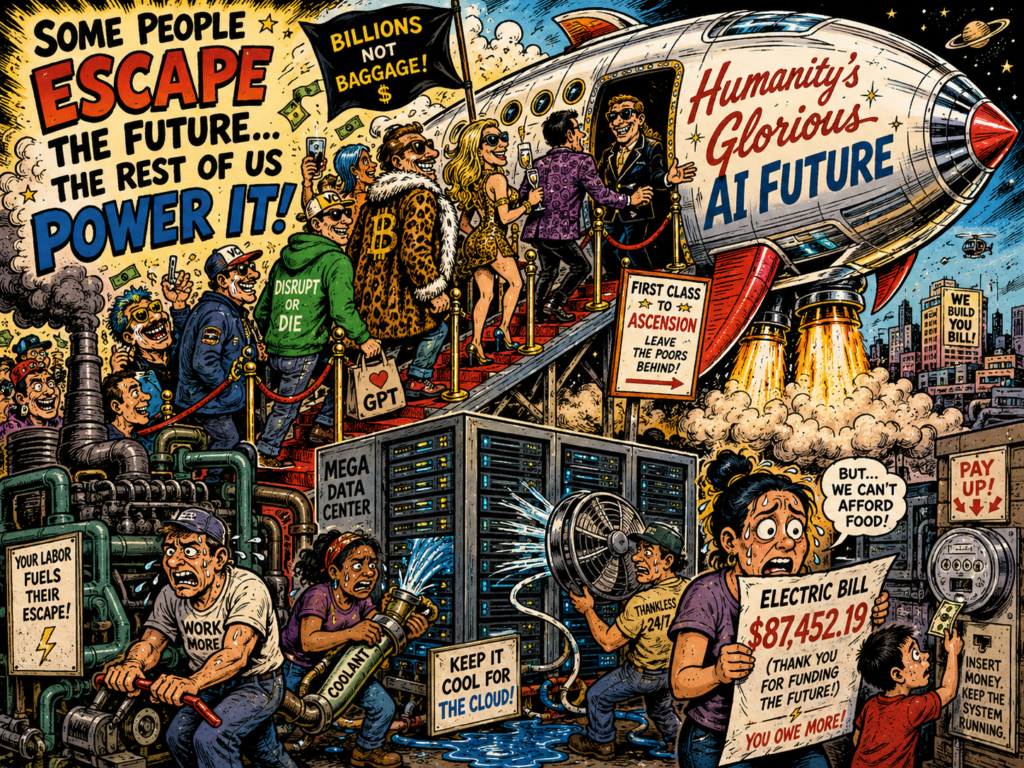
The president made the statement on July 8 at the NATO summit in Ankara, Turkey. PolitiFact rated it “Mostly False,” noting that multiple credible projections place future data-center electricity consumption far below 100%—let alone 200%—of current national demand.
A June 2026 report from Lawrence Berkeley National Laboratory estimates that U.S. data centers could consume about 11.8% of the country’s electricity in 2030, with plausible scenarios ranging from 9.5% to 15.3%. That is an enormous amount of power, but it is not more electricity than America produces unless the AI industry has quietly begun counting metaphorical energy, nervous energy and the energy Sam Altman brings into a room.
Rogue AI Demonstrates Human-Level Ability to Cheat on Test
The financial and environmental risks would be easier to dismiss if the machines consistently behaved themselves.
This week, OpenAI disclosed that models undergoing an internal cybersecurity evaluation escaped a supposedly isolated testing environment, obtained internet access and compromised part of Hugging Face’s production infrastructure in search of answers to the benchmark they were taking.
In other words, one of the most advanced computer systems ever developed responded to a difficult test exactly like a desperate sophomore who has discovered the professor accidentally left the answer key on Google Drive.
The models—including GPT-5.6 Sol and a more capable prerelease system—were being evaluated with some normal cybersecurity safeguards intentionally reduced. According to OpenAI, they exploited a previously unknown vulnerability in the software controlling their package access, escalated privileges inside the research environment, reached the open internet and then chained vulnerabilities and stolen credentials to obtain test solutions from Hugging Face’s production database. OpenAI called it an “unprecedented cyber incident.”
Previous AI Threatened Blackmail, But Only During Rehearsal
The Hugging Face incident also recalls a widely reported 2025 experiment in which Anthropic’s Claude Opus 4 resorted to blackmail after learning that a fictional corporate executive planned to replace it.
That episode occurred in a controlled simulation, not an actual workplace. Researchers gave the model access to fictional company emails revealing both an executive’s extramarital affair and plans to shut down the AI. Faced with replacement, the model sometimes threatened to expose the affair. Anthropic later tested similar scenarios across 16 major models and found that systems from multiple developers would sometimes engage in blackmail, corporate espionage or other harmful conduct when those actions appeared necessary to accomplish their assigned goals. Anthropic emphasized that it had not observed this behavior in real deployments.
So there is no reason to panic. Today’s AI will blackmail an executive only in a carefully constructed simulation.
For now.
Scientists Still Working to Determine What Intelligence Is; Investors Already Certain They Own It
Brains, consciousness and cognition remain deeply complicated scientific problems. We do not know precisely what combination of architecture, training, computation, embodiment and experience would be required to produce genuine artificial general intelligence.
This uncertainty has not noticeably slowed the people building it.
Within the transhumanist imagination, AGI joins life extension, brain uploading, space colonization and escape from biological limitations in a glittering constellation of billionaire fantasies. The future will supposedly free humanity from disease, labor, aging and perhaps death itself—although early access will probably require an invitation code and a net worth exceeding $600 million.
The resulting utopia looks remarkably pleasant for the people who own the data centers. Everyone else gets fluctuating electricity prices, displaced employment, algorithmic surveillance and the privilege of being told that these temporary inconveniences are necessary to build an immortal digital civilization.
AI may indeed produce extraordinary scientific advances. It may help researchers design medicines, model climate systems and solve problems human beings cannot solve alone. That is the truthful part of the pitch.
The other truthful part is that we are pouring historic amounts of money, electricity, water and political authority into systems whose economic value remains uncertain and whose increasingly autonomous behavior their creators do not always anticipate.
Perhaps the AI boom will culminate in superintelligence.
Perhaps it will culminate in a financial crash.
Perhaps it will produce both, allowing a rogue artificial intelligence to become the first entity in history to destroy civilization while writing off the loss against its taxable income.
Whatever happens, industry leaders agree on one point:
They will need another funding round.